
What is Design for Manufacturability (DFM)?
Design for Manufacturability (DFM) is the process of designing parts so they can be consistently and efficiently produced using plastic injection molding.
In injection molding, defects are often driven by design-related factors such as part geometry, mold design, material behavior, processing conditions, and cooling characteristics. These variables are closely interconnected, and small design decisions can significantly impact final part quality.
The DFM process evaluates these factors early to identify potential risks—such as warping, sink marks, or incomplete filling before tooling is built. By addressing these issues during design, DFM helps reduce defects, improve consistency, and minimize costly revisions during production. This is where Design for Manufacturability becomes critical.
These considerations are especially important in high-performance and regulated applications, including medical devices, defense components, and complex industrial systems.
Who performs DFM?
DFM in plastic injection molding is typically led by engineers at the contract manufacturer (CM), who bring expertise in mold design, material behavior, and processing conditions.
However, DFM is a collaborative process.
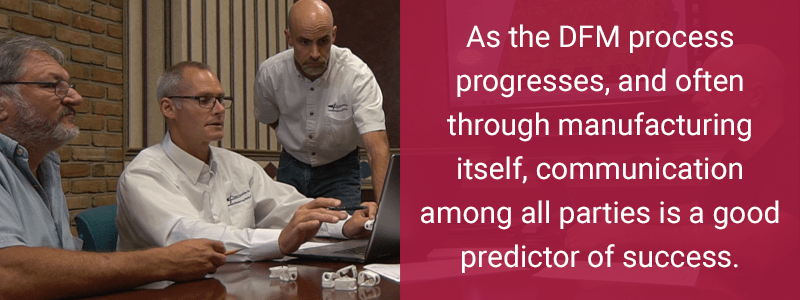
Engineers and product designers at the OEM play a critical role by providing detailed part designs, material specifications, and performance requirements. As the DFM process progresses, ongoing communication between OEM and CM teams helps ensure that design intent aligns with manufacturing realities.
Successful outcomes depend on early collaboration, shared technical understanding, and continuous feedback throughout both design and production.
What does the DFM process look like in plastic injection molding?
DFM can begin during the early concept phase, continue through design, and extend across the entire product lifecycle. Regardless of timing, the process follows a consistent set of steps focused on identifying and resolving manufacturability risks before production.
Analysis of Plans and Identification of Concerns
The OEM provides the CM with all relevant plans, documentation, and product information, including details about the component and its intended application.
CM engineers review this information to identify potential manufacturability risks. This includes evaluating part geometry, material selection, and any known concerns raised by the OEM related to performance or production.
DFM Simulation
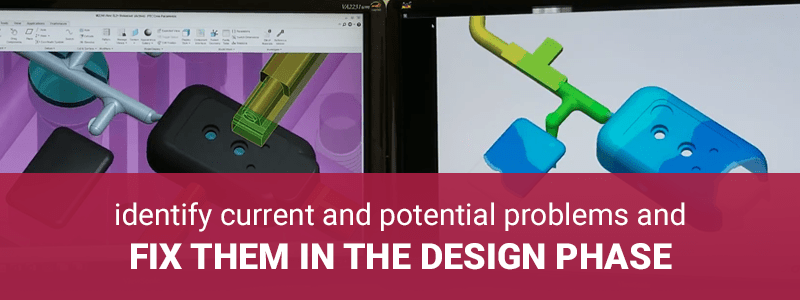
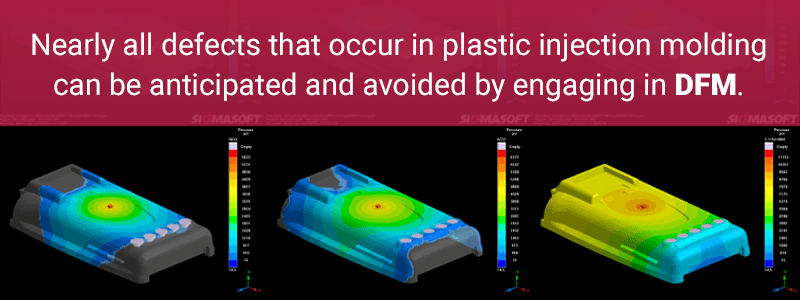
Engineers use specialized mold flow simulation software, such as Sigmasoft, to model the injection molding process.
These simulations replicate real-world conditions, including material flow, heat transfer, and potential warpage within a fully detailed mold environment.
Through simulation, engineers evaluate key variables and identify issues that could affect part quality—such as air traps, weld lines, sink marks, and thermal inconsistencies—before tooling is built.
During the simulation, engineers evaluate the design against key DFM parameters, using a structured checklist to identify potential risks before tooling is built.
👉 Get the DFM Checklist for Plastic Injection Molding
Presentation of Results and Recommendations
Following simulation, the CM provides a detailed report outlining findings and recommended design or process adjustments.
This typically includes:
- Simulation conditions (material, temperatures, timing, pressures)
- Material data and selection guidance
- Analysis of key molding parameters
- Comparisons of variable scenarios (e.g., packing pressure vs. sink)
- Identified risks and root causes
- Recommended design and process modifications
These insights allow OEM teams to make informed decisions before committing to tooling.
Prototyping, Testing, and Completion
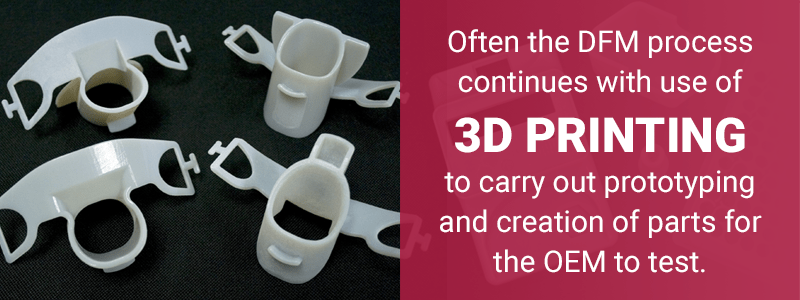
In many cases, the DFM process continues with prototyping using additive manufacturing or other methods to validate design assumptions.
Testing and iterative refinement may follow, ensuring that both design and process conditions are optimized before full-scale production begins.
Defects that occur in plastic injection molding can be caused by flaws in part design, mold design, material temperature, injection pressure and cooling time — nearly all of which can be anticipated and avoided by engaging in DFM.
Key Problems In Plastic Injection Molding
The most common plastic injection molding problems include:
Flash
A thin layer of plastic that flows outside of the cavity, typically where the two halves of the injection mold meet, creating a flap or excess material that must be trimmed. Flash decreases product quality, can add time to the manufacturing process, and damage your injection mold so avoiding plastic injection molding flash is necessary.
Weld Lines
A line, notch or color change on the molded part caused by the convergence of two separate flows of molten plastic, which can reduce aesthetics and/or strength. Creation of weld lines are unavoidable, but there are some considerations and ways to fix injection molding weld lines.
Sink Marks
A local depression on the surface of a part, typically caused by a part thickness that is too large for the resin type. Learn some common techniques for resolving sink marks for injection molded parts.
Short Shots
An incomplete part where the molten plastic does not fill the entire mold cavity, resulting in a portion where there is no plastic, e.g., a missing prong on a plastic fork. There are several causes for short shots and to remedy them depends on the causes for each individual case.
Burn Marks
Discolorations on the part surface that are often a dark black or red color, where plastic material overheated and burned against the injection mold.
Brittleness
Insufficient strength in the part, leading it to crack or break easily — has a variety of causes and remedies.
Delamination
Visible surface layers on the finished product that can be peeled — has a variety of causes and remedies.
Jetting
A deformation in the finished piece that can affect strength and aesthetics, occurring when some of the molten plastic material sprays into the mold cavity before the normal flow.
Sinks
Depressions in the surface of the piece, occurring when the mold is not properly filled or when excessive part thickness causes too much part shrinkage in a localized area.
Voids
Air gaps or pockets beneath the surface of the finished part, which can threaten the strength and structural integrity of the part and cause it to fail.
Splay
A cosmetic defect where moisture in the material creates streaks on the surface of the part.
Bubbles/blisters
Bubbles or blisters form when air cannot escape the mold cavity as the material is injected, which can affect strength and aesthetics.
Warping
Surfaces or walls on the part twist or bend as the part cools — has a variety of causes and remedies.
Flow lines
Visible streaks or waves in the surface of the part, caused by inconsistent cooling of the material.
Design for manufacturability greatly reduces or eliminates the most common defects that can occur with plastic injection molding. The case study below is just one example of how DFM was used to solve a set of problems in the plastic injection molding process.
Case Study: Solving Quality Issues for a Medical Device
When the OEM of a medical device was experiencing quality problems in the manufacturing phase, they turned to plastic injection molding CM Crescent Industries for a solution. The CM used design for manufacturing to eliminate these problems and create a value-added, problem-free manufacturing process.
Crescent Industries started by learning about the product, a device used to help heal broken bones through ultrasound, and discussing it with the OEM’s engineers. The OEM had been experiencing jetting of the substrate material in the clear window, and the parts were failing inspection because the windows were not clear. Based on the information gathered, the CM determined that the OEM’s current injection molding process was the root cause of the quality issues. It was likely that substrate material had been re-melting and mingling with the clear resin of the window as it was filling. The co-injection of three different materials was the manufacturing process that was causing the parts to fail.
Design revisions were needed to improve the process, but the OEM had only legacy data for the device. Rather than relying solely on 2D drawings and 3D solid models, Crescent Industries employed 3D printing to create prototypes demonstrating their recommended design modifications. The OEM was able to use the redesigned and 3D printed parts in their completed product assembly as if they were assembling and testing a unit that had gone through the entire manufacturing process. This approach not only shortened the time needed for redesign, but assured the OEM that they would be receiving a finished medical device that met their needs.
In all, the new approach for manufacturing the device included:
- Revising the product design
- Designing and building new tooling
- Implementing ultrasonic welding and product printing
- Other value-added manufacturing steps
Finding the Right Contract Manufacturer
Not all contract manufacturers are equipped to prepare your project for success using DFM. When looking for a plastic injection molding contract manufacturer, make sure to:
- Ask their sales team if they provide design for manufacturability as a service
- Consult their website for a description of their DFM services along with any DFM case studies of their past work
- Request to see the list of items they evaluate in their DFM process and compare it to the recommended checklist for DFM in plastic injection molding
- Establish that they employ engineers with extensive experience in custom plastic injection molding and injection mold tool building
- Set up a consultation with an engineer from their DFM team to discuss how they would handle your project
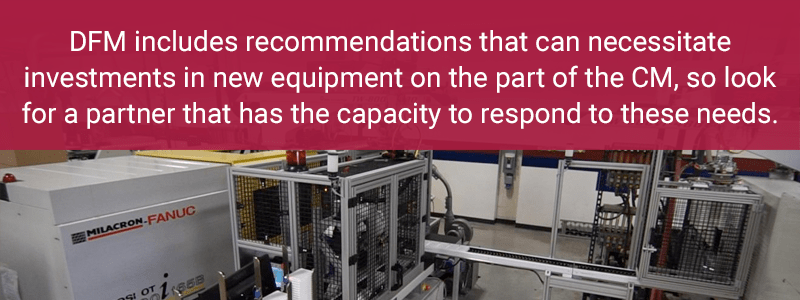
DFM includes recommendations that can necessitate investments in new equipment on the part of the CM, so look for a partner that has the capacity — the facilities and cash position — to respond to these needs.
A Successful Project Handoff
A successful plastic injection molding process starts with a successful handoff between the original equipment manufacturer and the contract manufacturer. When initiating a project, in addition to providing your CM with your CAD models, 3D models, other planning documents, as well as any existing prototypes or samples of previously manufactured iterations, expect to have at least one if not more DFM consultations with them. In these conversations, you’ll be sharing as many details as possible about the overall functioning of the product, beyond the part they’re manufacturing.
Understanding that some constraints may apply to sharing information about projects regulated by International Traffic in Arms Regulations and other policies, with a signed CDA and NDA in place, the more information your CM can have about the overall product’s use and functioning, the more they can do to make recommendations that result in the best possible design and manufacturing for your component. The best results from the DFM process come when the CM knows as much as the OEM’s engineers do about the end use of the product and all the different components that it interfaces with.
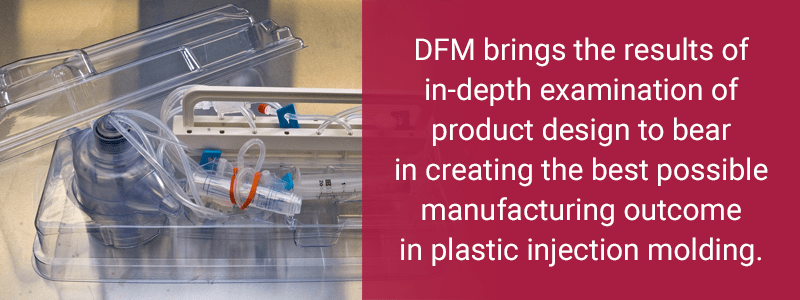
Design for manufacturability brings the results of in-depth examination of product design to bear in creating the best possible manufacturing outcome in plastic injection molding. By seeking out and engaging with a contract manufacturer skilled at DFM, original equipment manufacturers can produce plastic injection molded parts with confidence, knowing that the process will run smoothly and the resulting components will meet their needs.