Injection molding is a process with several distinct steps, each contributing to the quality of the finished product. The cooling step is crucial. Cooling occurs once the molten, liquid plastic material has been injected into the mold cavities. During this step, the material returns to a solid state, forming the finished part.
An improper injection mold cooling process, then, will almost always result in part defects that require rework or discard. The cooling process depends on the mold's cooling-channel design. If injection mold cooling system design is not done correctly, the following defects, problems, and inefficiencies may occur:
- Uneven or insufficient cooling can lead to shrinkage or warping throughout the part as areas cool at different rates. Proper cooling prevents parts from shrinking or warping.
- Cooling typically comprises up to 75% of cycle time, so it must be carefully controlled. Extra cooling time can exponentially increase cycle and production time.
- Part defects can reduce productivity if cycles must be rerun or rework is required to bring deformed parts to spec.
- Part defects also increase production costs, eating into your bottom line.
Types of Cooling in Injection Molding: Two Options
There are two primary types of cooling in injection molding — traditional cooling and conformal cooling. Each one is built on the general concept of cooling channels through which a cooling agent (such as coolant or water) can flow. Yet each is also quite different in terms of execution and results:
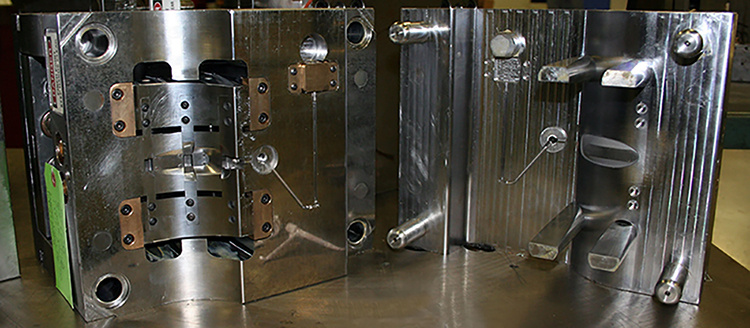
- Standard/traditional cooling: Traditional cooling involves cooling channels machined into the mold tool through standard methods such as drilling or milling. Channels created with these processes are straight, though they may intersect or be enhanced with additional devices such as baffles and bubblers. Standard cooling channel design works best for parts with relatively simple geometries, helping ensure the entire part cools effectively.
- Conformal cooling: Conformal cooling makes injection molding for more complex parts more accessible and effective. Conformal cooling introduces cooling channels that closely follow the geometry of more complex parts. This process helps these parts cool consistently, even in hard-to-reach areas.
Injection Mold Cooling System Design
Several important factors should be considered in cooling system design, regardless of the method used. Primary design factors include:
- Confirm that cooling channels are as close as possible to the thickest part of the mold cavity (i.e., the thickest part of the piece)
- Larger cooling channels should keep the same diameter throughout the mold
- Multiple smaller channels are better than a single large channel
- Consider heat transfer in mold material selection so that cooling is more effective
- Cool consistently in both halves of the mold
Several design aspects of cooling channels can help achieve good channel design. These include:
- Baffles: A baffle runs at a right angle to a main cooling line and is shaped like a semicircle. They increase the surface area the coolant can reach as it flows through one side of the baffle and out the other.
- Bubblers: A bubbler is a small channel running off a main channel that contains a tube. Like a baffle, it enables coolant to reach more surface area of the part. In a bubbler, coolant runs through the tube, then flows down the outside of the tube to return to the main cooling channel.
- Thermal pins: Thermal pins are filled with a fluid that cools by drawing heat from the mold, vaporizing, then condensing back to liquid as coolant reaches it. This cycle means that the process can continually repeat itself throughout each cycle.
With this understanding of the importance of cooling in injection molding and the methods and designs used to achieve effective cooling, you now have the knowledge to make a more informed decision about your mold design.
Crescent Industries offers extensive expertise in all cooling methods and mold design techniques. We are ready to work with you to determine the most efficient and effective design to achieve production efficiency and quality. Contact Crescent Industries today for more information.

Resources:
https://info.crescentind.com/blog/why-you-must-optimize-cooling-and-venting-in-plastic-injection-molds
https://sealectplastics.com/news/choosing-the-right-cooling-method-is-the-key-to-cycle-time-reduction
https://upmold.com/injection-mold-cooling-design/
https://www.moldmakingtechnology.com/articles/fundamentals-of-designing-the-optimal-cooling-system
https://www.moldmakingtechnology.com/articles/mold-cooling-options