Why Careful Quoting Matters for Complex Molded Parts
You're evaluating three quotes for a critical medical device component—a molded part with tight tolerances, multiple wall thicknesses, and demanding dimensional requirements.
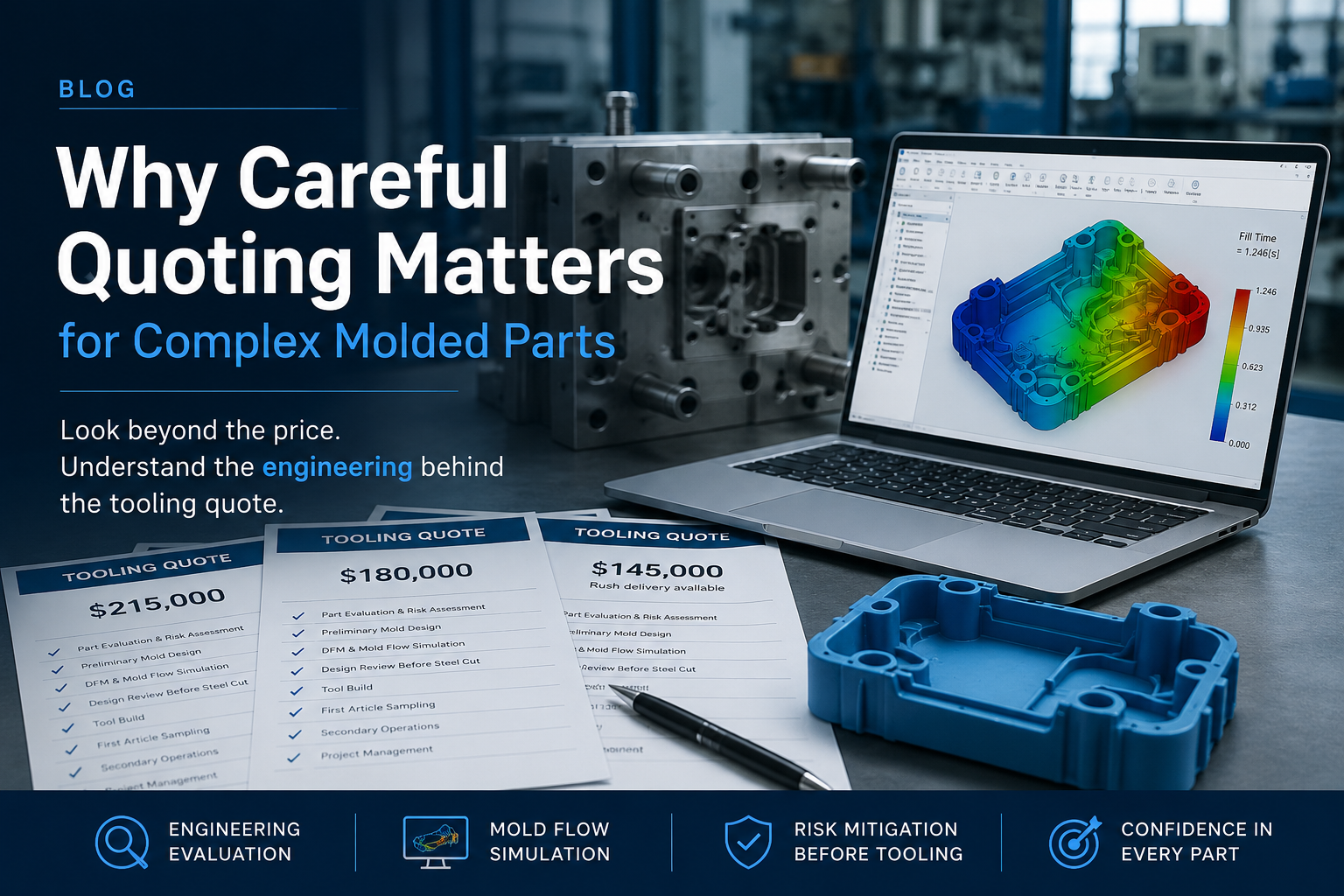
The first quote comes in at $180,000. The second is $215,000. The third—from a smaller shop—hits $145,000 with a note: "Rush delivery available."
Your procurement team flags the outlier. Your engineering team is torn. The pressure to hit budget is real, and the spreadsheet makes the math look simple.
Six months later, the reality is anything but simple.
You're in production, and dimensional issues emerge. The mold wasn't validated before steel was cut. Design problems surface during first article inspections. What looked like a $35,000 savings has turned into three months of delays, emergency re-tooling, and expedited shipping to your customer. The cheap quote became a six-figure problem.
What Was Actually Included in That Quote?
When you're sourcing a molded part for a regulated industry, you're not just buying plastic shaped into geometry. You're buying certainty. You're buying validation. You're buying the confidence that when that mold is built, and parts come off the line, they'll meet your specifications consistently.
Complex parts demand rigorous engineering before the mold is built. Your molding partner needs to understand the invisible engineering that goes into the quote: How will material flow through the cavity? Where should the gate be positioned to minimize stress concentration? How will cooling affect dimensional stability? Will wall thickness transitions create weak points or voids? How do draft angles and rib design affect both form and function? What secondary operations will the design actually require?
This is sophisticated work. It takes expertise, experience, and time. Most importantly, it needs to happen before you commit to building the mold—not after.
The problem is that not all quotes represent the same level of rigor. Some molders analyze the geometry, think through the mold strategy, and price accordingly. Others look at your drawing, estimate the steel and labor, and hope the design works. Both are quoting "a mold." But they're quoting entirely different things.
How Careful Molders Actually Quote
When a careful molder receives your part drawing, they don't just start pricing steel. They start thinking—and documenting what they find.
They begin with a detailed Design for Manufacturability analysis. This isn't generic feedback. They're analyzing your specific part against their process capabilities. They identify features that will inject beautifully and flag areas where your design might create challenges. They document this analysis and share it with you. This is their institutional knowledge applied to your specific geometry—not theory, but practical wisdom from years of running similar parts.
That analysis leads to a preliminary mold design. Before quoting, the careful molder has sketched out the actual mold strategy. Where will cooling lines run to ensure dimensional stability? How will the part eject without damage? What gates and runners make sense for your material and geometry? What's the wall thickness distribution going to mean for flow and cooling? This preliminary design isn't final—it will evolve—but it's real enough to quote accurately.
Now here's where the careful quoter separates from everyone else—and where the price difference often becomes clear.
A careful molder like Crescent includes mold flow simulation as part of the tooling cost. This isn't done during the quote. It's done after you accept the proposal and the project is awarded. Before any steel is cut, we run the simulation. We validate that the mold design we've proposed will actually produce parts meeting your specifications. We identify potential fill issues, predict gate freeze-off, spot weld lines, and verify that cooling will work as intended. We catch design problems before tooling, not during production.
But here's the critical differentiator: Not all molders provide this service. Some molders build the mold based on their preliminary design and hope it works. They skip the validation step entirely. Other molders offer simulation, but charge for it separately—it's an add-on service, not part of the quoted tooling cost.
At Crescent, mold flow simulation is built into the price. You're not paying an extra line item later. You're not discovering design flaws during first article inspection. The simulation work is part of what you're buying when you accept the quote.
A careful quoter has also thought about what happens after injection molding. Flash removal. Dimensional finishing. Surface treatment. Sterilization compatibility. They've either included these operations in their quote or been explicit about what falls outside their scope. There are no surprises hidden in assumptions.
Finally, the timeline reflects engineering rigor rather than aggressive scheduling. It includes time for mold flow simulation, design review, after project award, but before steel is cut. They're not rushing to the machine shop. They're building in the engineering discipline that catches problems before they become expensive.
The Risk Hidden in Low Quotes
In regulated industries, every mold-related issue becomes a compliance issue. A poorly evaluated design isn't just a performance problem—it's an audit problem. Your regulatory submission assumed certain specifications. If the mold doesn't deliver them, you have a documented deviation that requires investigation.
When you receive a quote that seems low, ask yourself what's not included: Is the molder skipping mold flow simulation entirely? Are they handling it as an optional service to be paid for separately? Are they taking your drawings at face value and building molds, hoping the design intent translates correctly? Have they actually performed a detailed design-for-manufacturability review, or are they using a template approach? Are they assuming you'll accept design compromises they haven't disclosed?
A molder who quotes without design for manufacturing plans isn't being efficient—they're transferring risk to you. And in regulated industries, that risk is expensive.
The difference between a $145,000 quote and a $215,000 quote isn't always about labor rates or shop efficiency. Often, it's about what's actually being quoted. One molder is including mold flow simulation and validation as part of the tooling cost. The other is quoting just the build, assuming your preliminary design is correct and hoping nothing needs to change.
What You're Actually Paying For
Here's what a truly careful quote represents: Your total investment in design validation is built into the price. DFM analysis and preliminary mold design happen during the quote phase. Mold flow simulation and validation happen after award, before steel is cut—and that work is already factored into what you're paying upfront. You're not paying extra for simulation later. You're not discovering design flaws during first article inspection. You're not compromising on geometry because "the mold can't hold that tolerance." The validation work is part of the contract.
When Crescent Industries quotes a complex molded part, you're receiving a mold design that has been rigorously analyzed for manufacturability, validated through simulation to predict real-world performance, optimized for your material and geometry, and designed to deliver parts that meet your specs consistently—before any tooling investment is made.
This validation work happens after you select us as your partner, but before we commit any steel to the machine. The cost is in the quote. The simulation is part of the mold build. Your certainty is part of the contract.
The Questions That Separate Partners from Vendors
When you're evaluating quotes for complex parts, the molders who answer these questions thoughtfully are the ones providing careful engineering:
"What specific DFM analysis have you performed on this part?" Listen for specifics about your design, not generic responses. A careful molder can point to wall thickness concerns, gate placement considerations, or material flow challenges they've identified.
"Can you walk me through your proposed mold design and gate strategy?" A careful molder can discuss this specifically. They've thought about where cooling lines will run, how ejection will work, and why they've chosen the gate location they have.
"Will mold flow analysis be performed on this mold?" This is the key question. Ask if simulation is included as part of the tooling cost or charged separately. Ask when it happens in the timeline. A molder who includes mold flow analysis as part of the quoted price is committing to validation before steel is cut.
"What happens if mold flow analysis reveals design issues?" A careful molder has contingency for design iteration. They've budgeted time and approach for solving problems before tooling is committed.
"What's included in your quote versus what falls outside?" Get a clear breakdown. Mold flow simulation, secondary operations, sterilization compatibility testing, design history file support, and timeline should all be explicit. If simulation is listed as "optional" or "to be quoted separately," that's a critical distinction.
The Real Choice
Low quotes exist. Sometimes they're from genuinely efficient molders with lean operations and smart processes. Often, though, they're from molders who are avoiding validation commitments. They're quoting the steel and labor, not the design assurance. They're betting the preliminary design is correct and hoping you won't discover problems until production.
In regulated industries, that bet is dangerous.
A quote that includes mold flow simulation as part of the tooling cost costs more upfront. But it eliminates the expensive discovery phase. It catches problems during simulation, not during production. It gives you confidence that your mold will produce spec-compliant parts consistently, month after month, year after year.
For complex parts in medical devices, defense, and regulated industrial applications, you can't afford to discover problems late. Mold flow validation isn't a luxury. Its foundation.
Complex molded parts deserve more than a line-item price. Let's discuss your project and walk through the engineering considerations, validation approach, and tooling assumptions behind a comprehensive quote. Contact our Team!
Topics:
Related Articles
-
Jun 24, 2026
Why Careful Quoting Matters for Complex Molded Parts
Read MoreYou're evaluating three quotes for a critical medical device component—a molded part with tight...
-
Jun 10, 2026
Questions to Ask Before Launching a New Molded Component Program
Read MoreA strategic guide for engineering and procurement leaders
You're standing at a crossroads. Your...
-
Jan 14, 2026
Shortlisting U.S. Injection Molding Partners for Regulated Industries
Read MoreThe U.S. injection molding industry accounted for $42.85 billion in revenue in 2022 and is expected...